Transforming organisations through enterprise-wide interventions
Transforming Organisations need an enterprise-wide intervention plan. So what actually determines an organisations culture?

Research suggests that effective negotiation depends on recognising when a familiar strength is no longer serving the conversation and knowing how to shift.
Sales teams have never had more data, technology and training to help them prepare for customer conversations. Yet when budgets tighten, objections get tougher and commercial pressure rises, even well-prepared deals can start to unravel at the negotiation table.
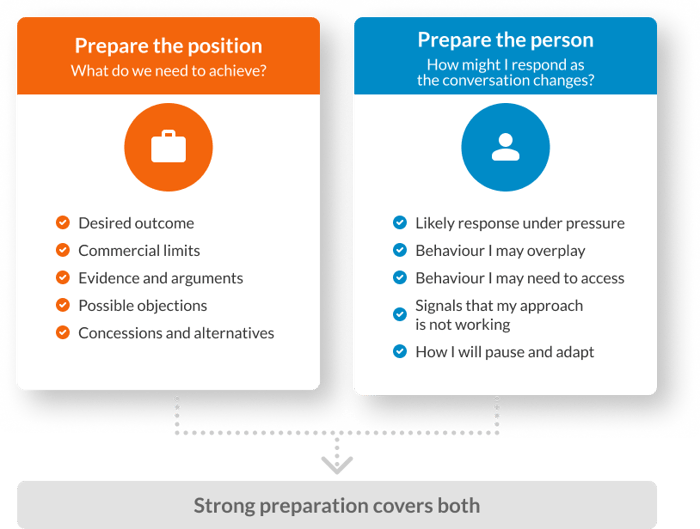
Because when a customer challenges a proposal, salespeople can have very different responses. One might push the purchase more forcefully onto the client. Another might be keen to protect the relationship and lose sight of their priorities. Someone else may stick so closely to the original script that even as new information is shared, they struggle to move forward. The problem isn't necessarily poor preparation. It's that sales preparation often focuses on the position – the desired outcome, commercial limits, evidence, objections and concessions – without preparing the person for how they may respond when the conversation doesn't go to plan.
Once the conversation begins, the CRM, sales process and carefully prepared plan can only take someone so far. The salesperson still has to be able to read what is happening in the room and adapt to what the conversation requires most in that moment.
And that's where behavioural adaptability becomes a critical commercial skill.
Negotiation calls for more than one way of operating. There are moments to stand firm and moments to stay curious; times to focus on the result and times to protect the relationship. The top sales performers aren't necessarily those with one naturally effective style. They're the ones who can recognise when their usual approach is no longer working and adapt their behaviour to what the customer and conversation require.
It can be tempting to look at your top sale performers and ask what sets them apart. Are they more confident? More persuasive? Better at building relationships? More disciplined in their preparation? Research suggests it's not that simple.
Confident, outgoing individuals may seem more persuasive. Cooperative people often find it easier to build trust. Those who are highly conscientious are likely to arrive well prepared, with clear objectives and a firm grasp of the detail. Yet personality research does not reveal a personality type that consistently produces the best results. What it shows is something more useful for sales leaders: different people bring different strengths to a negotiation, and the value of those strengths depends on the customer, context and moment (Sharma et al., 2013).
Personality can influence whether someone pushes a point or looks for common ground, how they respond to disagreement, how readily they share information and how comfortable they are making or resisting concessions. But it does not determine how successful they will be.
Take assertiveness. It can help a negotiator set a strong anchor, challenge assumptions and defend value. But when it leaves too little room for listening, it can restrict the flow of information and turn constructive challenge into a contest for control (Barry & Friedman, 1998; Falcão et al., 2018). When a customer challenges the price, for example, a direct response may help the salesperson defend the value of the offer. But if every concern is treated simply as an objection to overcome, they may miss what is really preventing the customer from moving forward.
Cooperation can build trust, keep the conversation productive and encourage both parties to discuss what genuinely matters. Yet an overemphasis on harmony may lead to early concessions or reluctance to challenge unfavourable terms (Amanatullah et al., 2008). A salesperson keen to protect an important relationship may agree to changes in price, scope or delivery before understanding what the customer actually values or whether a concession is needed at all.
Preparation is not an automatic advantage either. Conscientious negotiators often bring structure, discipline and persistence, but research has found no consistent link with better negotiation outcomes (Sharma et al., 2013). This does not mean preparation is unhelpful. It suggests that a highly structured approach may offer less value when the situation requires improvisation, exploration or a willingness to revise the original plan. Preparation strengthens a negotiation when it creates clarity; it becomes a limitation when it reduces curiosity or makes new information harder to act on.
The same quality can help one negotiation and hinder another. Much depends on the customer, the context and how far that behaviour is taken. The real skill is noticing what the moment requires rather than simply doing more of what comes naturally.
For sales leaders, this shifts the development question. Rather than asking how you can get more people to sell like your top performers, the opportunity is to help each salesperson understand the strengths they naturally bring, recognise when those strengths are serving them and adapt when the situation needs something different.
The behaviours that make someone effective in one sales conversation can work very differently in another.
Being direct can help defend value. Being accommodating can strengthen an important customer relationship. Being logical can bring clarity to a complex decision. But under pressure, people can lean more heavily on the behaviours that feel most natural. Rather than adapting their approach, sellers may lean further into the behaviours that feels most familiar. A useful Quality can then become ineffective simply because it is being used too much for what the situation requires:
These patterns can reinforce themselves. A forceful response may cause the customer to withdraw, which prompts the salesperson to push harder. Concern about damaging the relationship may lead to another concession. A focus on what is immediately workable may prevent both sides from finding a more valuable solution.
The aim is not to suppress these qualities. Each has an important role in negotiation. The key is developing your sales team to notice when their strengths have begun to cross the fine line from between effective and ineffective behaviour during the conversation and consciously choosing to adapt their response in the moment.
Behavioural adaptability doesn't mean asking salespeople to change who they are or adopt a sales style that doesn't feel like them. It's about giving them greater awareness around their natural tendencies and approach and helping them recognise when the conversations need something else so they can adapt their behaviour to remain effective.
Alongside preparing what they want to achieve from an important negotiation, salespeople can also prepare for how they might respond as the conversation changes.
These three questions may help:
1. What might I overplay?
Think about what tends to happen when you face a challenge, pressure or stress. Do you become more forceful, offer more explanation, retreat into the detail or begin making concessions to keep the customer engaged? Start with the value of that behaviour. Then consider the point at which it could begin to work against you.
2. What might the customer need from me?
A customer who is hesitant may not need a more persuasive argument. They may need more time, clearer evidence or the opportunity to voice a concern that has not yet been addressed. Equally, a positive and collaborative conversation may still require a direct discussion about boundaries, price or expectations. The aim is not to mirror every customer response. It is to notice what will help the conversation progress.
3. What will tell me it is time to shift?
Pay attention to changes in the interaction. The customer may begin repeating an objection, contributing less information, withdrawing from the discussion or agreeing unusually quickly. These signals do not always mean that the customer is being difficult. They may indicate that the current approach is no longer creating a useful conversation.
A brief pause can be enough to interrupt the pattern. Ask another question. Summarise what you have heard. Revisit an assumption. Introduce a different option. Sometimes the most valuable move in a negotiation is not pushing ahead but creating enough space to see what has changed.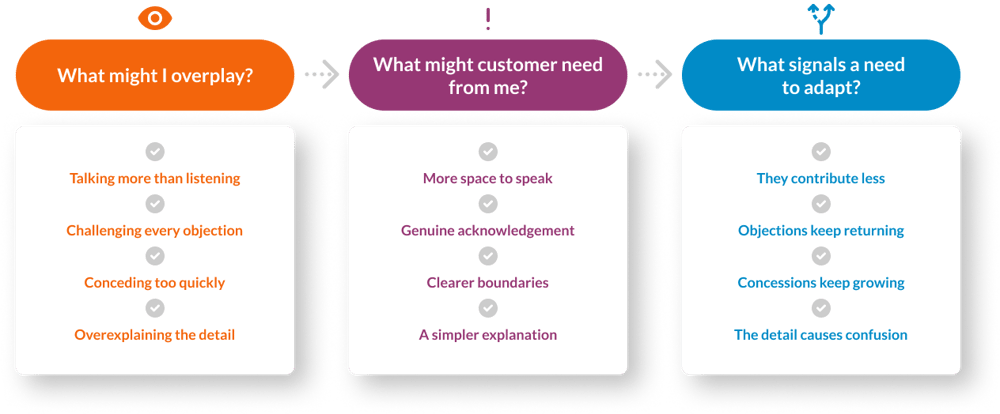
These questions can also create richer coaching conversations. Rather than only reviewing what happened in a negotiation, sales leaders can explore which behaviours someone relied on, how those behaviours affected the customer and what they might choose to do differently next time. Over time, this helps move development beyond learning a negotiation process towards building the behavioural adaptability to use that process effectively with different customers and in different situations.
This Sales Team Behaviour Map can help you see how your sales team really shows up, and exactly where they can adapt to win more of the right business. Before their next sales conversation, help your salespeople identify one strength they may overplay, one complementary behaviour they will use deliberately and they signal that will prompt you to pause and adapt.
The three questions above offer a useful way to prepare. The harder task is applying that awareness while the conversation is moving quickly, the customer is pushing back and commercial pressure is building. Knowing that you need to adapt is one thing. Recognising your own patterns while a negotiation is unfolding – and choosing a different response in the moment – is much harder.
For sales leaders, this is where self-awareness needs to become a team capability. That doesn't mean creating one ideal way of selling or asking everyone to behave like your top performers. Different people will naturally bring different strengths to a customer conversation. The opportunity is to help each salesperson understand the behaviours they rely on, recognise the impact those behaviours have on different customers and build the range to respond differently when the situation requires it.
A shared language for behaviour can make those conversations easier. Instead of only reviewing whether a deal was won or lost, sales leaders can explore what happened within the conversation. What did the salesperson notice? Which strengths did they lean on? How did the customer respond? Where might that strength have become overextended? What could they draw on next time?
Over time, those conversations can help salespeople become more intentional about how they show up – not only in negotiations, but across changing customers, stakeholders and commercial situations.
Negotiations are rarely decided by the plan alone. They are shaped by the small choices made as the conversation changes: when to press a point, when to ask another question, when to pause and when to rethink an assumption. The more clearly salespeople understand their own behavioural patterns, the more choice they have in those moments. And helping people turn that awareness into behavioural adaptability may be one of the most valuable capabilities a sales leader can develop across their team.
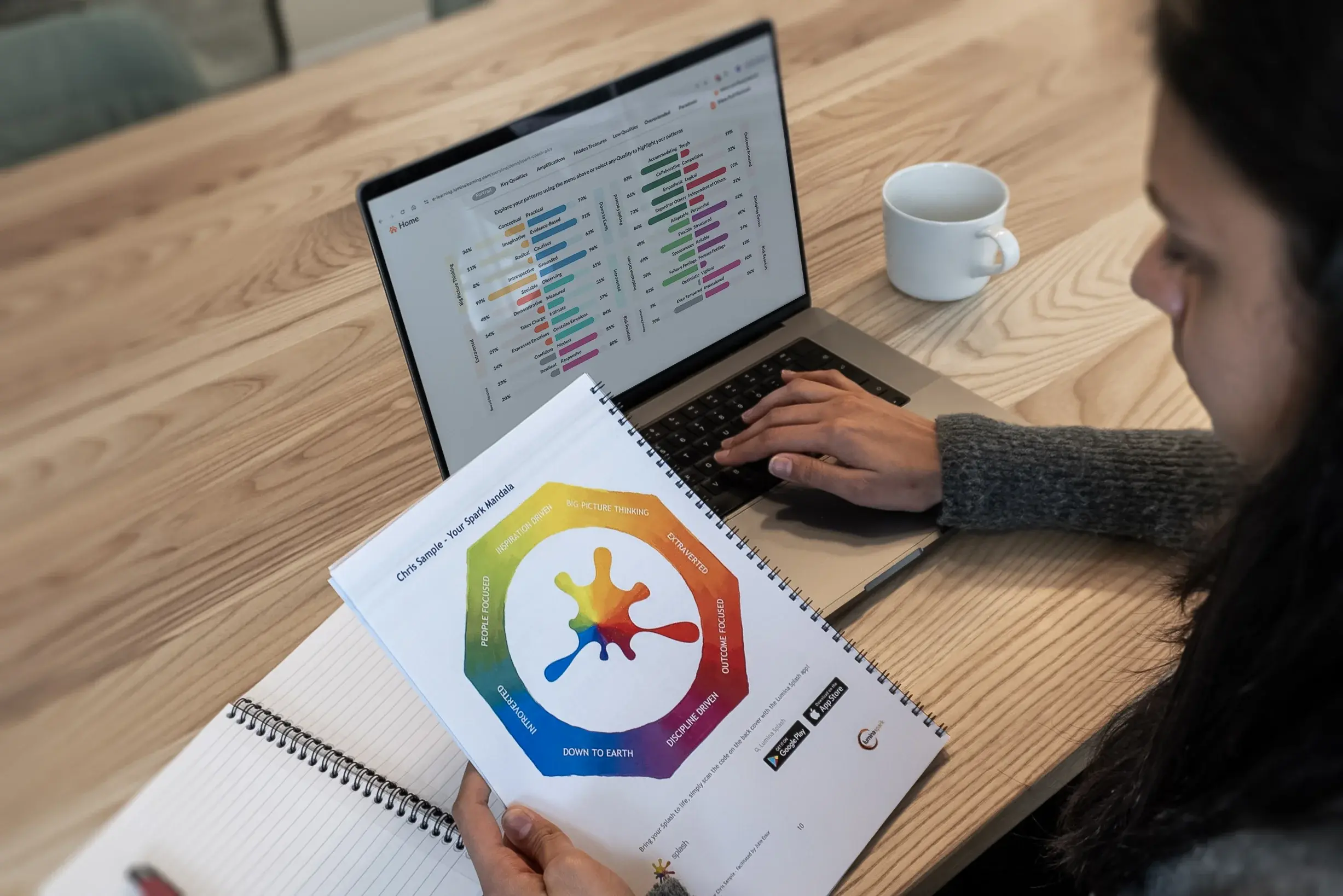
Transforming Organisations need an enterprise-wide intervention plan. So what actually determines an organisations culture?
Discover how to integrate soft-skills development into daily work using the Lumina Splash app, fostering lasting behavior change in modern workplaces.
Discover how the Lumina Splash app enhances ongoing team and leadership development, making learning a seamless part of everyday work.