



Whizz kidz
Discover how Whizz-Kidz transformed its internal communication, teamwork, and leadership through strategic interventions and the Lumina Spark program.
As part of their 2017-2021 strategy, KFAS sought to increase capacity for innovation in youth and business. Specifically, they wanted to empower and skill up Kuwait’s private sector employees in collaboration with leading international research- and academic-based institutions.
The Kuwait government established KFAS to nurture an environment that fosters curiosity, creativity, builds confidence, and creates a thriving learning culture for a sustainable Kuwait. Their mission is to inspire, influence, and enable the advancement of science and innovation to enrich research, business, and talent.
The objective was to equip these future leaders with the skills to generate and implement great ideas, in themselves and others, advancing corporate management and yielding business growth to create a thriving culture for a sustainable Kuwait.
At the ATD Conference 2018, KFAS sought a world-leading international partner with whom to collaborate to provide a program for 25 delegates, enabling executives and managers to stay ahead of business trends in innovation.
KFAS identified a need for a tailored program, aimed at Kuwaiti private sector executives, to develop innovative future leaders who can generate great ideas to advance corporate management and yield business growth.
Scientific research around the neurophysiological basis of creativity and innovation has explored how the brain works to support creativity and innovation. At Lumina Learning, we have built on this research, working with various organizations to develop creativity and innovation programs that recognize the need for a holistic approach to developing innovative thinking and action among individuals.
Our research indicated a close link between personality preference, thinking style and an individual’s approach to innovation. Consequently, we developed a ‘Colorful Thinking’ Model to provide a link between thinking styles and behavioral preferences to help raise self-awareness and openness to different innovative and creative approaches. The development was informed by Dewberry, Juanchich and Narendran (2013) with evidence for the relationship between personality and thinking styles, Ettlie, Groves, Vance and Hess (2014) linking thinking styles and innovation intentions, and de Bono (1995) using thinking styles to increase creativity.
KFAS, encouraged by our thinking, were excited to use this bottom-up approach, placing the individual at the center and then helping them determine other critical factors to increase effectiveness on different levels:
Our primary learning outcomes focused on enabling participants to:
Additionally, we needed to ensure learning:
An international collaborative project working with KFAS-Kuwait to design and deliver a 3-day program to develop innovative future leaders.
Lumina partnered with industry experts to combine academic psychological knowledge with practical expertise and experience to create this powerful learning experience that would continue beyond the classroom. The program was designed to be relevant, data-driven, highly interactive, and practical to engage and inspire.
To guarantee the best outcome for our participants and stakeholders, our approach consisted of 5 stages. Critical to success was the need to:

Lumina Spark had been chosen to underpin the Innovation program because we believed it would enhance outcomes for the client by improving self-knowledge with some tangible personal developmental needs to further individual innovation and team mapping.
![innovation-model-1[1]](https://luminalearning.com/hs-fs/hubfs/innovation-model-1%5B1%5D.png?width=467&height=350&name=innovation-model-1%5B1%5D.png)
![spark-mandala[1]](https://luminalearning.com/hs-fs/hubfs/spark-mandala%5B1%5D.jpg?width=350&height=350&name=spark-mandala%5B1%5D.jpg)
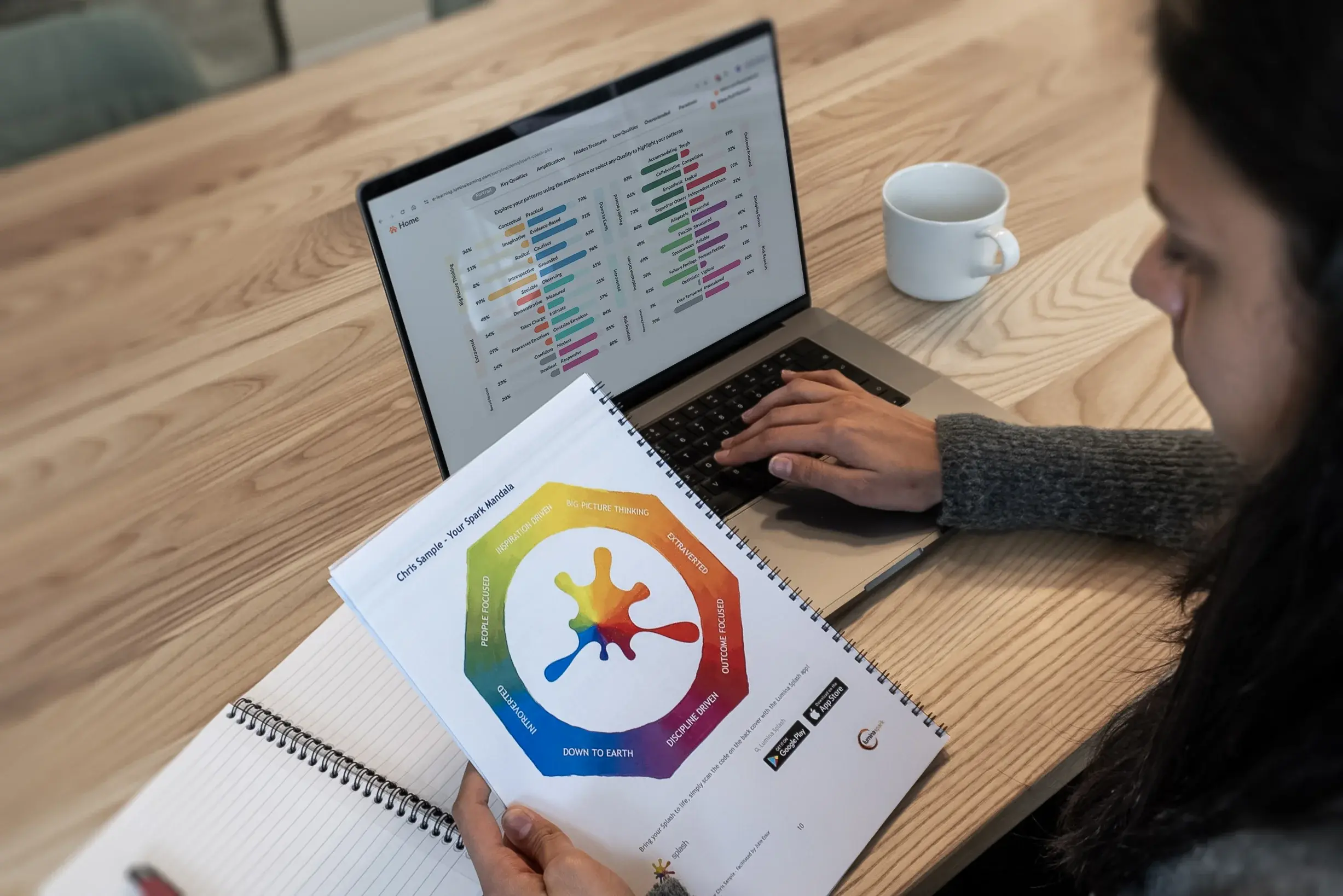
Kuwaiti Nationals have had very limited exposure to psychometrics, so our starting point was to underpin the psychological aspects of innovation through better understanding of self. By raising self-awareness, it enabled participants to open themselves up to the creative techniques for innovation. Day 1 centered on our Colorful Thinking model and Lumina Spark personality model to raise awareness of how personality traits and natural thinking styles can both support and block innovation in the individual. Self-knowledge was critical.
![innovation-model-2[1]](https://luminalearning.com/hs-fs/hubfs/innovation-model-2%5B1%5D.png?width=350&height=350&name=innovation-model-2%5B1%5D.png)
![innovation-model-3[1]](https://luminalearning.com/hs-fs/hubfs/innovation-model-3%5B1%5D.png?width=622&height=350&name=innovation-model-3%5B1%5D.png)
![innovation-4[1]](https://luminalearning.com/hs-fs/hubfs/innovation-4%5B1%5D.png?width=300&height=225&name=innovation-4%5B1%5D.png)
Day 2 we explored the working process of innovation within teams using our Innovation by Design model. This enabled participants from a wide range of organizations, many of whom were in management/team leader positions, to take their learning back to their individual organizations and teams.
Day 3 explored organizational challenges and barriers preventing innovation, e.g. managing change through resisting systems. It was designed around ‘handing over the reins’ and providing all the necessary means to embed learning in the workplace.
We were delighted to be shortlisted for the ABP 2020 annual awards process through the KFAS project. Below is our project overview video shared with the ABP.
Our outcome evaluation was determined and mapped during the assessment of the initial challenge encouraging us to work backwards when designing the training.
We collected multiple methods of feedback and data to understand the value and measure of success of the work undertaken. This process included:
Following the program, several participants contacted us directly regarding the impact of the training, illustrating the quality and value delivered.
Post-program we conducted a facilitator review (comprehensive qualitative data based on facilitation experience) of the daily objectives and content delivery. This helped us to self-assess the training impact and reflect on our own learning.
This review highlighted the importance of taking an iterate approach to course design/delivery and the power of partnership working. Our approach was underpinned by science, theory, and data, but application focused on achieving a balance between theory and approach to ensure participants left with awareness, appreciation, and behavioral Competency to apply what had been taught across the three days.
The design phases highlighted the relevance of each model included and illustrated the significance of the transition facilitation between these models to allow participants to experience their personal journey to put their learning into practice. It was acknowledged in our post-course review that with a large group, the design allowed little flexibility for any tangential discussions. For future courses we would build in more time for group-based discussions to maximize shared learning value.
To truly understand the value-add, participants were asked to rate their knowledge pre-and post-training. The mean score was 6.5/10 before training rising to 8.67/10 afterwards, indicating participants felt the learning outcomes had been achieved through the program.
Attendees were also asked to rate the extent to which they felt:
To understand the enduring impact of our intervention, four weeks after course completion, we checked in with participants regarding individual actions plans set and what they had implemented since completing the course.
The feedback received showed many references to applying Colorful Thinking to problem/thought sessions and Innovation by Design for enhancing innovation at a team-based level.
Some individuals had shared Spark with colleagues to understand how they can work collaboratively toward innovative behavior, and three others had set up specific interventions.
Some had also tried the creativity techniques from the Treasures Guide, and Gavin Howden, Lumina’s IT Team Leader, has implemented ‘10% time’ dedicated to creative thinking within his own team as discussed in this video. These observable, tangible applications provide evidence of the added benefit this program has had on its attendees, which is highly unlikely to have occurred without this program.
One of the delegates, a local Kuwaiti citizen and senior executive in a local bank, reported:
“I’d like to really thank you all for this amazing opportunity. It has been an amazing 3-day workshop which was extremely inspiring and energizing! I also got the chance to network with a lovely group. So many things to take back! Once again, thank you!”.
Discover how Whizz-Kidz transformed its internal communication, teamwork, and leadership through strategic interventions and the Lumina Spark program.
Learn how personal and professional leadership development using Lumina products can transform educational environments and enhance staff...
Discover how Lumina Learning's Women's Executive Leadership Programme empowers female leaders in Japan, boosting confidence and leadership skills...