

Research

Sometimes the best ideas are the simplest ones. For example, the Lumina Spark questionnaire measures introversion and extrersion separately, something you might be surprised to learn that many other tools do not do.

At Lumina Learning, we see the value in measuring both ends of a scale as equally positive, avoiding the evaluative bias found in many assessments.

The Evolution of Lumina Learning

1. Greek origins

The ancient Greeks developed the theory of humors, categorizing people into four types: phlegmatic, melancholic, sanguine, and choleric. For its time, this was a leading personality theory, based on what the Greeks understood about the body rather than the mind.

With hindsight, Eysenck demonstrated that the Greeks had identified two factors later validated within the Big Five. Lumina Spark refers to these as introversion/extraversion and risk orientation (risk-reactive vs. reward-reactive).

2. Credit to Jung

Carl Jung’s (1921) theory of personality marked a significant advancement beyond the humors and has served organizations well as a practical model for building self-awareness for many decades. Like the Greeks, Jung identified introversion and extraversion, along with two additional dimensions: thinking/feeling and intuition/sensing.

However, his work was based on case studies and anecdotal observations rather than statistical analysis. It is a testament to Jung’s insight that his theory correctly identified what would later be validated as three of the Big Five factors. Lumina Spark refers to these as Introversion/Extraversion, People Focused/Outcome Focused, and Big Picture Thinking/Down to Earth.

3. Origins of the Big5

In 1936, Allport and Odbert compiled a list of over 4,500 terms in an effort to identify the core components of personality. In the 1940s, Raymond Cattell built on this work and proposed 16 personality factors. Later, Fiske (1949) identified limitations in Cattell’s analysis and concluded that five factors could account for personality variation. While Eysenck proposed three factors and Ashton later suggested six, the five-factor model gained increasing support.

It was not until the 1950s, when Tupes and Christal advanced this research, that the first formal version of the Big Five model emerged. Norman replicated their findings in 1963, and the model gradually became the dominant framework for academic personality research.

4. The Barren Years

The 1960s and 1970s were challenging for personality research, as behaviorists and other academics questioned its validity (notably Mischel’s 1968 critique of trait theory). However, in the business world, these concerns had limited impact. Practitioners continued to use personality models—often based on Jung’s work—favoring what worked in practice over purely academic debates.

Myers and Briggs expanded Jung’s model, adding another dimension to align more closely with the Big Five. Meanwhile, researchers such as Digman and DeYoung identified higher-order factors that grouped the Big Five into broader domains. More controversially, Musek proposed a single general factor of personality. While academically interesting, this “Big One” has seen little practical application. Overall, the momentum of research gradually returned in favor of personality theory.

5. The Development of Lumina Spark

In the 1980s and 1990s, the Big Five became the leading academic framework, with Costa and McCrae’s model (1992) setting the standard for research. Lumina Spark was designed to integrate best practices from both Big Five and Jungian models for use in selection and development within organizations.

In particular, Lumina Spark retains the Jungian principle of valuing both ends of each spectrum equally—without resorting to rigid personality “types.” It combines the empirical rigor of Big Five research with a practical, intuitive Jungian lens to help individuals understand their personality.

In 2009, the Lumina Spark model was embedded into Lumina Learning’s cloud-based platform, making innovative digital solutions accessible to clients around the world.

A New Approach

DSC09377

mockuuups-office-setting-with-the-iphone-mockupDon't Force the Choice

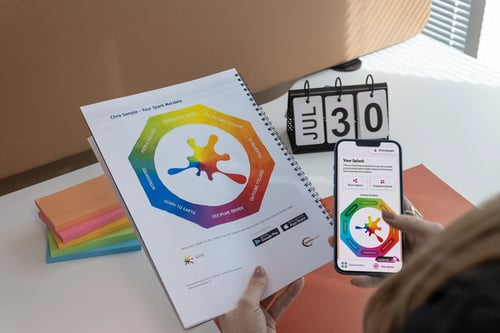
One unique feature of the Lumina Spark questionnaire is that it measures both ends of each polarity separately. In contrast, most Jungian-based instruments ask questions such as, “Do you prefer to go to parties or stay in and read a book?” This “forced choice” approach requires individuals to label themselves as either extraverted (a partygoer) or introverted (a reader)—when in reality, this is a false dichotomy.

With Lumina Spark, individuals are not required to make a false choice. Each end of the polarity is assessed through separate questions, allowing participants to express that they enjoy both going to parties and staying in to read—or neither.  This is achieved using a five point Likert scale to provide the learner with more responses so that they can accurately express their views. 

DSC08580-2-Edit-2All of your personality, all of the time

When working within organizations to support development, research shows that the ability to develop and integrate both ends of a polarity is highly beneficial. For example, Lumina Learning helps individuals understand how to balance strong people skills with a drive for results.

By measuring three personas—Underlying, Everyday, and Overextended—Lumina Learning creates a single, comprehensive portrait of personality that reflects the full individual, eliminating the need for additional assessments or models.

Rather than measuring one end of a polarity in everyday behavior and the opposite end only when overextended (capturing only part of the personality some of the time), Lumina Learning measures all three personas across both ends of each polarity—capturing all of your personality, all of the time.

Comparing Jungian, Big 5 & Lumina Factors

 
Jungian / 5 measures Big 5 / 5 measures Lumina Spark / 10 measures
Introvert OR Extravert / I or E Extraversion / E+ to E- Extraversion E+ / Introversion E-
Feeling OR Thinking / F or T Agreeableness / A+ to A- People Focused A+ / Outcome Focused A-
Intuition OR Sensing / N or S Open to Experience / O+ to O- Big Picture Thinking O+ / Down to Earth O-
Judging OR Perceiving / J or P Conscientious / C+ to C- Discipline Driven C+ / Inspiration Driven C-
Typically not measured Neuroticism / N+ to N- Risk Reactor N+ / Reward Reactor N-
 

Jungian vs. Lumina Spark Assumptions 

The left hand column shows the Jungian assumptions that have been used for several decades. The contrasting Big5 and Lumina Spark assertions are outlined in the right hand column.
 
Jungian Assumption Lumina Spark / Big5 Latest empirical research

A total of four factors define personality. These factors are “bimodal,” meaning individuals must fall at one end of each polarity—for example, a person must be either introverted or extraverted, but not both.

Personality is better understood through five factors, not four. These factors follow a normal distribution rather than a bimodal one. Modern research, such as Tett’s Trait Activation Theory, suggests individuals may express different traits in different contexts—challenging the oversimplification of fixed “types.” Lumina Spark reflects this by recognizing that individuals can be both introverted and extraverted, depending on the situation.

Each of the four factors has two polarities.

An individual is assigned to one of the polarities across each of the four factors. For some individuals this assignment is clear cut and they strongly associate with one polarity. However, for some individuals their score can be closer to the mid-point and the reading of their type is less clear.

Nevertheless, after this assignment, each individual can be located in a cell within a 4 x 4 matrix of 16 personality types.

Within each of the five factors are sub-factors that Lumina Learning terms 'Qualities'. Individuals can score anywhere on a continuum and the concept of 'type' as described by Jung is simply not empirically justifiable.

Forcing an arbitrary typing split in the middle of a normally distributed factor has the unintended consequences of damaging the test/re-test reliability of the sixteen types. Put simply, it is psychometrically unappealing for an individual to answer just one question differently in a questionnaire and then flip to become a different type.

Of the four functions - sensing, intuition, thinking and feeling - the one that is 'dominant' is not determined by the highest score of the four, but instead by a calculation based on the additional judging and perceiving factor.

 Furthermore, the judging and perceiving factor determines the order of an individual's eight Jungian attitudinal functions (yet this ordering has little empirical support).

To determine the relative intensity of the five factors does not require a calculation based on the judging and perceiving scores. Instead, a simpler approach suggests the degree of preference an individual has for a factor is determined by the strength of their score in it.

 Furthermore, rather than making unsupported assumptions about the order of use of different Qualities, the intensity of each Lumina Spark Quality in each of the Three Personas is measured directly and normed without the need for any complex assumptions. 


Join the small-but-mighty monthly update enjoyed by thousands